PRODUCT / OPERATIONS
“What happens when a label fails after allocation?”
Trace a workflow through the actual states, conditions and fallbacks.
 ODIN
JOIN #ODIN-BOT
ODIN
JOIN #ODIN-BOT

AN INTERFACE TO WHAT SHIPPIT ACTUALLY RUNS
Understand product behaviour, integrations and technical decisions from the code that powers them.
THREADSTHE PROBLEM IS NOT A LACK OF DOCUMENTS
Specs describe intent. Project pages capture a moment. Chat preserves opinions.
Odin answers from the implementation that exists now. If the evidence is incomplete, it says so.
Odin is deliberately narrow. It does not search every company document and hope the most confident sentence is current.
THE INTERFACE IS A THREAD
Every response starts with a direct conclusion, explains the behaviour, then shows the evidence behind it.
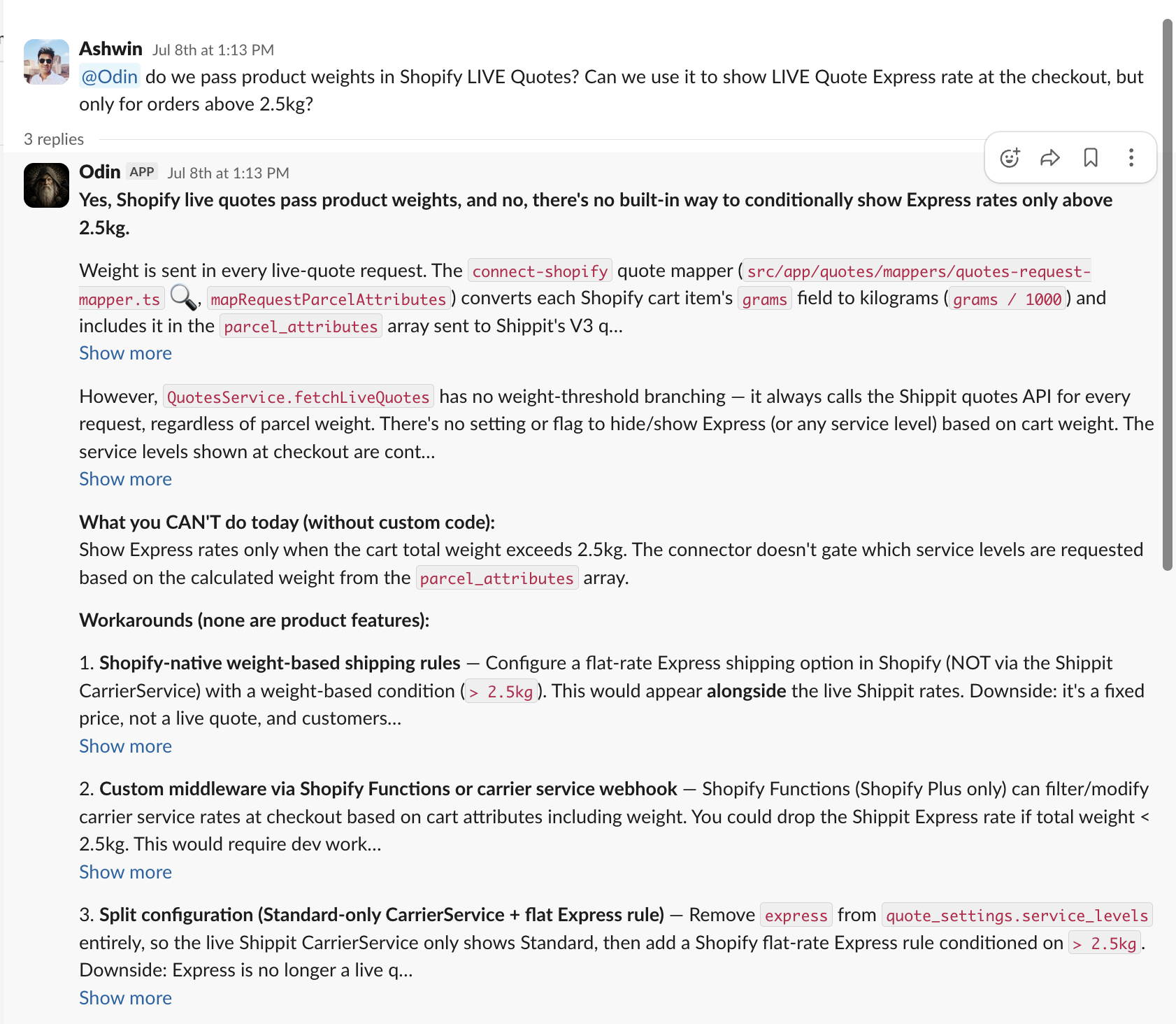
Odin investigates in a bounded, read-only loop. It cannot change the code it reads.
Join #odin-bot and mention @Odin in the channel or a thread.
Odin traces the question through its codebase map and relevant repositories.
Claims are checked against current files, identifiers and pull requests.
The result returns to the same thread with its evidence status attached.
Start with the behaviour you need to understand. You do not need to know which repository contains it.
Trace a workflow through the actual states, conditions and fallbacks.
Check what the integration implements—not what an old enablement page promised.
Find the owning service, entry point and exact implementation evidence.
Build shared understanding from the connector behaviour and the code that powers it.
A NARROW TOOL IS A TRUSTWORTHY TOOL
No. Use the operational data tools designed for that purpose.
No. Code can show what exists; it cannot establish a commitment or launch decision.
No. Its investigation tools are read-only.
Odin marks the answer as partially confirmed or not confirmed instead of filling the gap.
AVAILABLE TO EVERYONE AT SHIPPIT